


A project is a temporary endeavor undertaken to create a unique product, service, or result. Project Management is the application of knowledge, skills, tools, and techniques to plan, execute, monitor, and complete a specific project. Project management ensures that a project achieves its goals within scope, time, cost, and quality constraints. It is the backbone of delivering successful projects, ensuring that teams can efficiently organize, prioritize, and deliver tasks.
Key components of project management include:
- Scope: Defining what the project will deliver.
- Time: Establishing and adhering to a timeline.
- Cost: Managing the budget and resources.
- Quality: Ensuring deliverables meet expectations.
- Risk: Identifying and mitigating potential issues.
- Stakeholder Communication: Keeping everyone informed and aligned.
Two dominant methodologies used in project management are Agile and Predictive (Waterfall). These approaches represent different philosophies and structures, each suitable for specific types of projects.
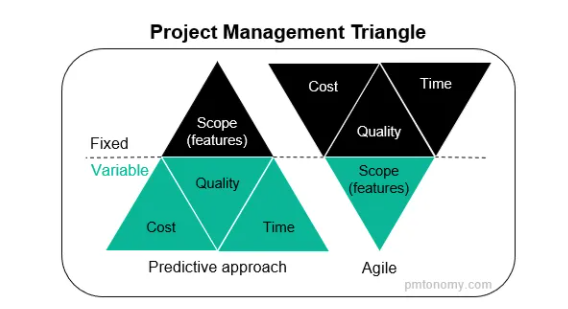
Predictive Project Management (often referred to as the Waterfall model) is a traditional, linear approach to managing projects. It follows a structured sequence of phases where the project’s scope, cost, and timeline are clearly defined and agreed upon at the beginning. This approach is based on the assumption that all project requirements can be determined upfront.
Agile is a mindset and approach to work that emphasizes flexibility, collaboration, and a commitment to delivering value to the customer. It encourages adaptive planning, iterative development, and continuous improvement. Historically, Agile began as a methodology to improve software development processes, focusing on enhancing team collaboration and efficiency. Over time, it has evolved into a broader philosophy that can be applied across industries and functions.
What is Predictive Project Management?
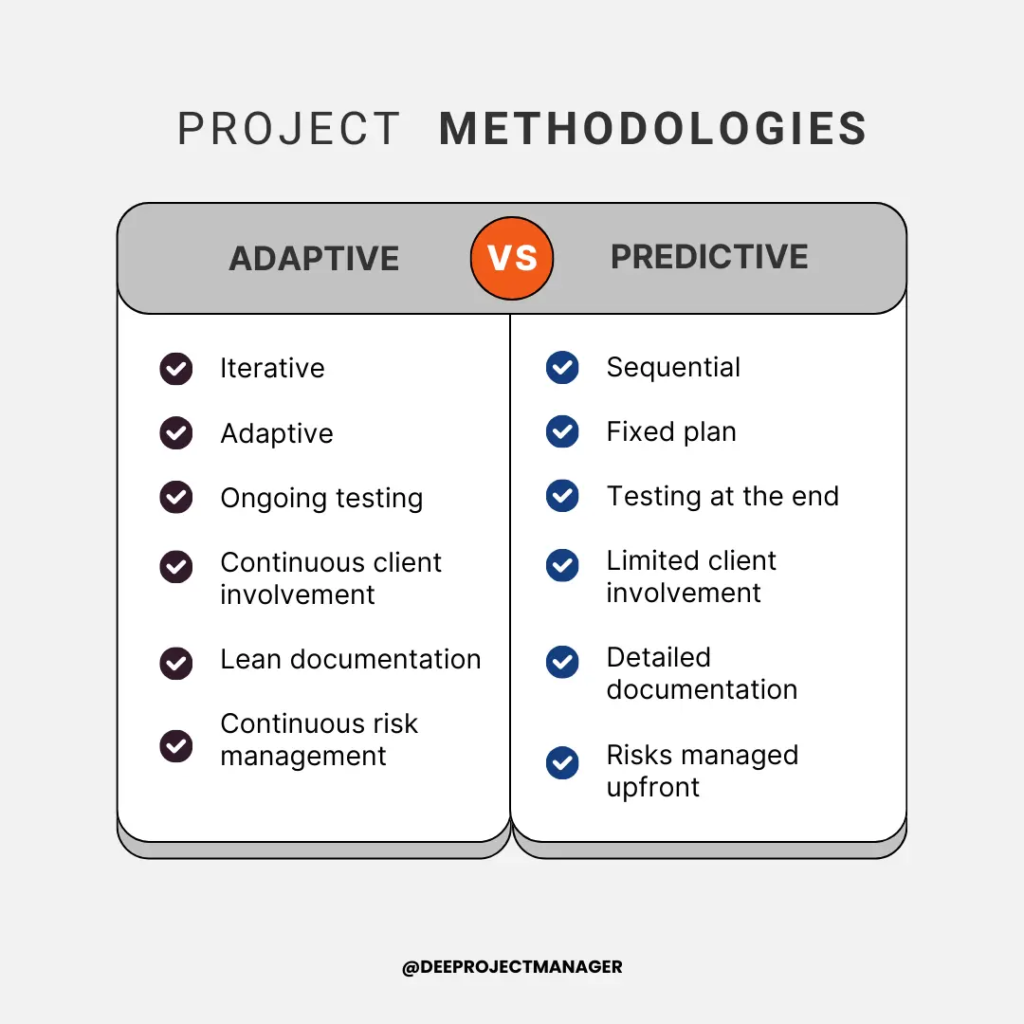
Predictive Project Management (often referred to as the Waterfall model) is a traditional, linear approach to managing projects. It follows a structured sequence of phases where the project’s scope, cost, and timeline are clearly defined and agreed upon at the beginning. This approach is based on the assumption that all project requirements can be determined upfront.
Key Characteristics of Predictive Project Management:
- Sequential Phases: The project progresses through a fixed sequence of phases:
- Initiation
- Planning
- Execution
- Monitoring and Controlling
- Closure
- Extensive Upfront Planning: Detailed documentation is created for requirements, timelines, costs, and risks before execution begins.
- Limited Flexibility: Changes during the project lifecycle are difficult and costly to incorporate.
- Defined Outcomes: The final deliverable is specified early, and the team works toward that predefined outcome.
Advantages of Predictive Project Management:
- Provides clear structure and documentation.
- Makes it easier to manage projects with fixed timelines and budgets.
- Works well for industries with strict regulations or standards.
- Reduces uncertainty, as all steps are planned before execution.
Disadvantages of Predictive Project Management:
- Rigid process with limited adaptability to changing requirements.
- High risk of failure if initial assumptions are incorrect or incomplete.
- Delayed value delivery since outcomes are typically delivered at the end of the project.
When to Use Predictive Project Management:
- The project has clear and stable requirements that are unlikely to change.
- Deliverables are well-defined and documented upfront.
- The industry or project type involves significant regulatory or compliance requirements (e.g., construction, aerospace, pharmaceutical development).
- Changes are costly or difficult to implement after the project starts.
What is Agile Project Management?
Agile project management is an iterative approach that emphasizes collaboration, user feedback, and rapid response to change. It involves breaking down projects into smaller, manageable parts, allowing teams to adapt and evolve their work processes as the project progresses.
Developed initially for software development in the early 2000s, Agile has since expanded into various industries like marketing, finance, and product development. The Agile Manifesto, created by 17 software developers in 2001, outlines four core values:
- Individuals and interactions over processes and tools.
- Working software over comprehensive documentation.
- Customer collaboration over contract negotiation.
- Responding to change over following a plan.
These values are supported by twelve principles, which emphasize flexibility, customer satisfaction, iterative progress, and team empowerment. (https://agilemanifesto.org/principles.html)
Agile is effective because it focusses on continual learning and adaptation. It is an evolutionary approach to getting things done. Traditional projects depend on a definition of requirements – a clear statement of each aspect of the work that needs to be done – but Agile approaches accept that you can’t know all of those requirements until you start work and start to learn about the problem.
Traditional project management puts a significant emphasis on management of risk. Agile, on the other hand, avoids such risks by reacting quickly, efficiently and in a controlled manner to deal with problems and issues as they arise.
Agile is not just ‘free-form’ or ‘random’. Agile has a well-developed discipline of tools, techniques, behaviours and thinking that drive progress towards a successful project conclusion.
Key Features of Agile:
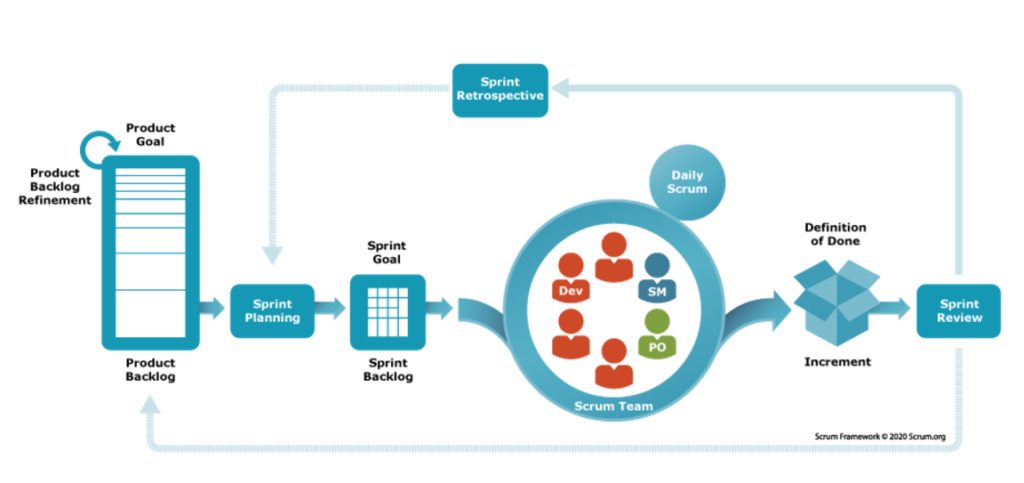
- Iterative Development: Agile breaks down a project into small, manageable chunks called iterations or sprints (typically lasting 1-4 weeks).
- Collaboration: Regular communication between teams and stakeholders ensures alignment with project goals.
- Customer-Centric: Agile encourages customer feedback throughout the project to ensure the product meets expectations.
- Flexibility: Agile teams are equipped to handle changes in scope, priorities, and requirements without significant disruptions.
Popular Agile Frameworks
Agile can be implemented using different frameworks, each with unique processes and tools:
- 1. Scrum
- 2. Kanban
- 3. Extreme Programming (XP)
- 4. SAFe (Scaled Agile Framework)
What is Scrum?
The term “Scrum” in Agile project management is directly inspired by the sport of rugby, where a “scrum” refers to a tightly-knit, collaborative formation of players restarting play after a minor infraction. Similarly, Scrum in project management emphasizes teamwork, collaboration, and quick adaptability to achieve a shared goal.
Scrum is an Agile framework designed to help teams deliver value incrementally and iteratively. It provides a structured approach to planning, executing, and improving work, typically in short cycles called sprints (1-4 weeks). It is lightweight, simple to understand, but challenging to master.
Core Concepts of Scrum
- Sprints:
- A Sprint is a time-boxed iteration (usually 1-4 weeks) where a team works on completing a specific set of tasks.
- The goal is to deliver a potentially shippable product increment by the end of each sprint.
- Team Structure: Scrum defines three key roles:
- Product Owner:
- Represents the customer and stakeholders.
- Responsible for defining and prioritizing the Product Backlog.
- Scrum Master:
- Ensures the team adheres to Scrum principles.
- Facilitates meetings, removes impediments, and helps the team improve.
- Development Team:
- A self-organizing, cross-functional group responsible for completing the work.
- Product Owner:
- Transparency:
- Work is made visible to all stakeholders through artifacts (e.g., backlog items, progress updates) and regular ceremonies.
- Empiricism:
- Scrum relies on three pillars of empirical process control:
- Transparency: Everyone understands what is happening.
- Inspection: Regular checks on progress and challenges.
- Adaptation: Adjustments based on inspection findings.
- Scrum relies on three pillars of empirical process control:
Scrum Framework Components
1. Scrum Roles
| Role | Responsibilities |
|---|---|
| Product Owner | Defines the product vision, creates and prioritizes the backlog, and ensures the team delivers value. The Product Owner acts as a bridge between customer needs and the technical team. Instead of commanding tasks to be done, they motivate the team and guide them effectively to ensure the product is developed in the best possible way. |
| Scrum Master | Guides the team in applying Scrum, facilitates meetings, and removes blockers. The Scrum Master does not act as a “manager” but rather takes on the role of a “facilitator” or “coach.” They enable the team to self-manage and support them in this direction. |
| Development Team | Delivers the product increment. The team is cross-functional and decides how to achieve the Sprint Goal. |
2. Scrum Artefacts :
The term “artefact” comes from the Latin arte factum, from ars skill + facere to make meaning “something made with skill.” In Scrum and Agile methodologies, the term “artefact” is used to describe key documents, tools, or outputs that provide transparency, help manage work, and facilitate communication among team members. These artefacts are essential for the Scrum process and support its core values of transparency, inspection, and adaptation.
| Artifact | Purpose |
|---|---|
| Product Backlog | A prioritized list of all desired work for the project, maintained by the Product Owner. Product Backlog is a key artefact in the Scrum framework, serving as a prioritized list of all requirements, features, improvements, and bugs for the product development process. This list defines what the product should be and guides the development process. |
| Sprint Backlog | A selection of Product Backlog items chosen for a sprint, along with a plan for completing them. It is a list of tasks that the development team commits to completing during a Sprint. The Sprint Backlog includes everything necessary to achieve the Sprint Goal, providing a clear plan for the team to focus on. |
| Increment | One of series of regular additions and contributions. The usable result of a sprint. In scrum, a product increment is whatever you previously built, plus anything new you just finished in the latest sprint, all integrated, tested, and ready to be delivered or deployed. It must meet the team’s Definition of Done (DoD). |
3. Scrum Events
| Event | Purpose |
|---|---|
| Sprint Planning | To define the Sprint Goal and plan the work for the sprint. |
| Daily Scrum | A 15-minute meeting where team members discuss progress, obstacles, and plans for the day. |
| Sprint Review | Held at the end of the sprint to showcase the increment and gather feedback from stakeholders. |
| Sprint Retrospective | A meeting to reflect on the sprint and identify improvements for the next iteration. |
How Scrum Works?
- Product Backlog Creation:
- The Product Owner creates a list of all tasks, features, and improvements needed in the product.
- Sprint Planning:
- At the beginning of each sprint, the team selects tasks from the Product Backlog to work on.
- A Sprint Goal is set to provide focus.
- Execution:
- During the sprint, the Development Team works collaboratively to complete the tasks.
- Progress is tracked using tools like task boards or software (e.g., Jira, Trello).
- Daily Scrum:
- Every day, the team holds a short meeting to align on progress, identify blockers, and adjust plans.
- Sprint Review:
- At the end of the sprint, the team demonstrates the completed work to stakeholders for feedback.
- Sprint Retrospective:
- The team reflects on what went well, what didn’t, and how they can improve.
- Increment Delivery:
- The increment is delivered to stakeholders and may be released to users if it meets the Definition of Done. The Scrum Guide says the Definition of Done is a formal description of the state of the Increment when it meets the quality measures required for the product.
What is Kanban?
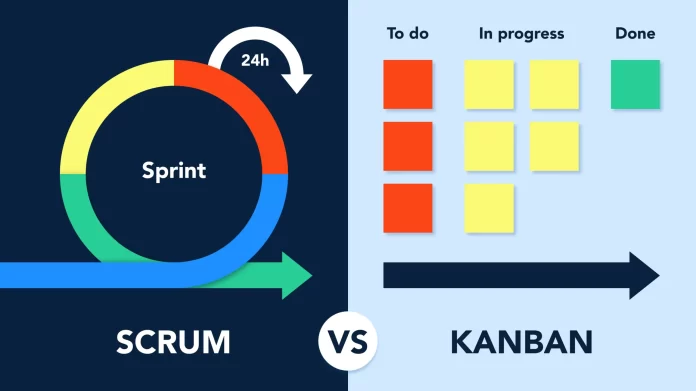
Kanban is considered an Agile methodology, but it is slightly different from other Agile frameworks like Scrum or Extreme Programming (XP). Kanban, meaning “signboard” or “billboard” in Japanese, originated from Toyota’s lean manufacturing system in the 1940s to improve production efficiency. In recent years, the Kanban template, originally used in manufacturing, has been adapted for project management, particularly in software development, and has achieved significant success. Using Kanban for project management is an effective way to visualize workflows, improve efficiency, and foster collaboration within teams. Unlike Agile, which focuses on time-boxed sprints, Kanban is a visual workflow management tool that emphasizes continuous delivery and optimizing flow.
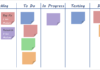
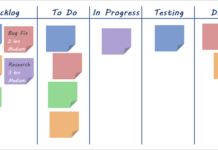
Tasks on Post-it notes (real or virtual) become the kanban cards, which move back and forth across designated columns representing stages of completion: “backlog,” “work in progress (WIP)” and “completed,” for example. These categories are visual representations of kanban’s value stream, the steps a team takes to create maximum value.
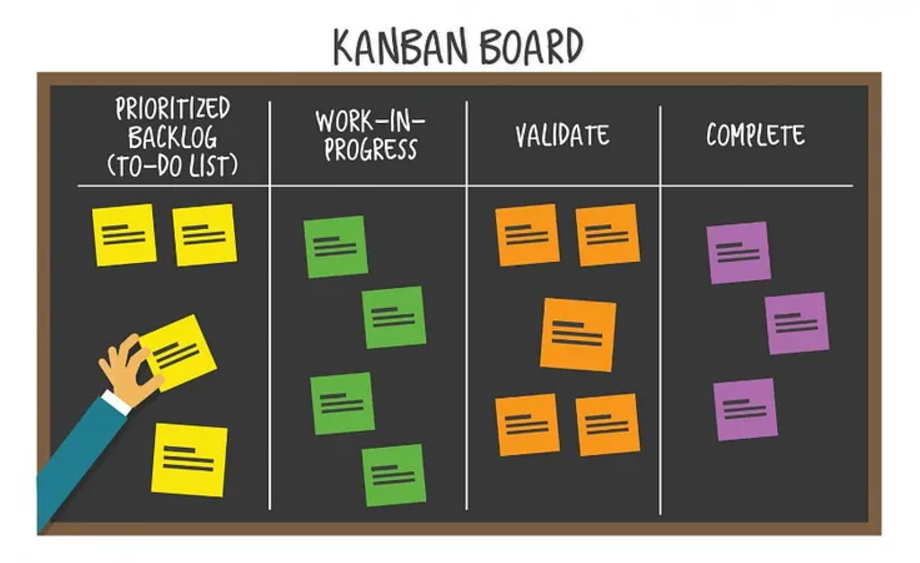
Core Principles of Kanban:
- Visualize the work: Tasks are displayed on a Kanban board, which typically consists of columns like “To Do,” “In Progress,” and “Done.”
- Limit work in progress (WIP): By capping the number of tasks in progress, Kanban prevents overloading team members and promotes focus.
- Manage flow: Teams track how tasks move through the workflow to identify bottlenecks and areas for improvement.
- Continuous improvement: Kanban encourages a culture of ongoing refinement and optimization of processes.
Key Features of Kanban:
- Continuous Delivery: Unlike Agile, which works in sprints, Kanban enables a continuous flow of work, making it more suitable for ongoing projects.
- Flexible Planning: Tasks are prioritized on an as-needed basis, allowing teams to adapt quickly to changes without disrupting the overall workflow.
- Focus on Flow Efficiency: By managing the flow of tasks and limiting work in progress, Kanban aims to reduce waste, streamline processes, and improve productivity.
Comparing Scrum and Kanban
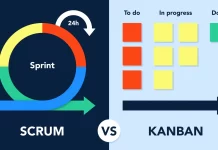
Kanban and Scrum are both Agile methodologies that help teams manage workflows and improve efficiency. While they share similarities, they are fundamentally different in their structure, approach, and use cases. Here’s a detailed comparison:
| Aspect | Kanban | Scrum |
| Definition | A visual workflow management system focusing on continuous delivery. | A structured Agile framework focused on iterative development in sprints. |
| Origin | Derived from Lean manufacturing (Toyota Production System). | Originated from software development, inspired by rugby team collaboration. |
| Workflow | Continuous flow: tasks are pulled as capacity allows. | Time-boxed sprints (usually 1-4 weeks) with a fixed set of tasks. |
| Work in Progress (WIP) | Limits are explicitly set for each stage of the workflow to avoid overloading the system. | No explicit WIP limits, but sprint backlog ensures work is limited within a sprint. |
| Task Management | Tasks can be reprioritized at any time; no strict deadlines. | Tasks are locked for the duration of a sprint. |
| Roles Defined | No predefined roles; teams can be self-organizing. | Defined roles: Product Owner, Scrum Master, Development Team. |
| Facilitator | No specific facilitator role; responsibilities are shared. | The Scrum Master ensures adherence to Scrum principles and removes obstacles. |
| Planning | Continuous, task-by-task planning; tasks are pulled into the workflow as needed. | Planning happens at the start of each sprint during Sprint Planning meetings. |
| Delivery Cadence | Continuous delivery; work is released as soon as it is ready. | Delivery happens at the end of each sprint (incremental delivery). |
| Estimation | No formal estimation; tasks are worked on based on priority and capacity. | Tasks are estimated (e.g., using story points) during sprint planning. |
| Meetings | No mandatory meetings; teams may have ad hoc reviews or retrospectives. | Mandatory ceremonies: Sprint Planning, Daily Scrum, Sprint Review, Retrospective. |
| Daily Interaction | Not required but encouraged for collaboration. | Daily Scrum (15-minute stand-up) is a core part of Scrum. |
| Board | Uses a Kanban Board with columns representing workflow stages (e.g., To Do, In Progress, Done). | Uses a Scrum Board to track sprint backlog tasks and their progress. |
| Visualization | Focuses on visualizing the entire workflow to identify bottlenecks and optimize flow. | Focuses on tracking sprint progress and task completion within a sprint. |
| Key Metrics | – Cycle Time: Time taken to complete a task. – Throughput: Number of tasks completed over time. – Cumulative Flow Diagram: Visualizes task movement through stages. | – Velocity: Average story points completed per sprint. – Burndown Chart: Tracks progress toward sprint completion. |
| Flexibility | Highly flexible: Tasks can be reprioritized and workflow stages adjusted at any time. | Less flexible: Changes are discouraged during a sprint; focus is on delivering the sprint goal. |
| Team Size | Works well for teams of any size, particularly those with a steady flow of work (e.g., support teams). | Best for small, stable teams working collaboratively on well-defined goals. |
| Ideal Scenarios | – Continuous delivery of work (e.g., support, maintenance). – Dynamic priorities where work must be reprioritized often. | – Projects with well-defined goals that can be broken into iterations. – Teams that prefer structured processes and clear time-boxed goals |
When to Use Scrum vs. Kanban
- Scrum is best suited for projects with evolving requirements, such as software development, where flexibility, customer feedback, and rapid delivery are crucial. It works well for teams that thrive on structure and iterative progress with defined deadlines.
- Kanban is ideal for projects focused on optimizing processes, reducing bottlenecks, or improving workflow. It is highly effective for operational tasks, such as support, maintenance, or any project where priorities frequently shift.
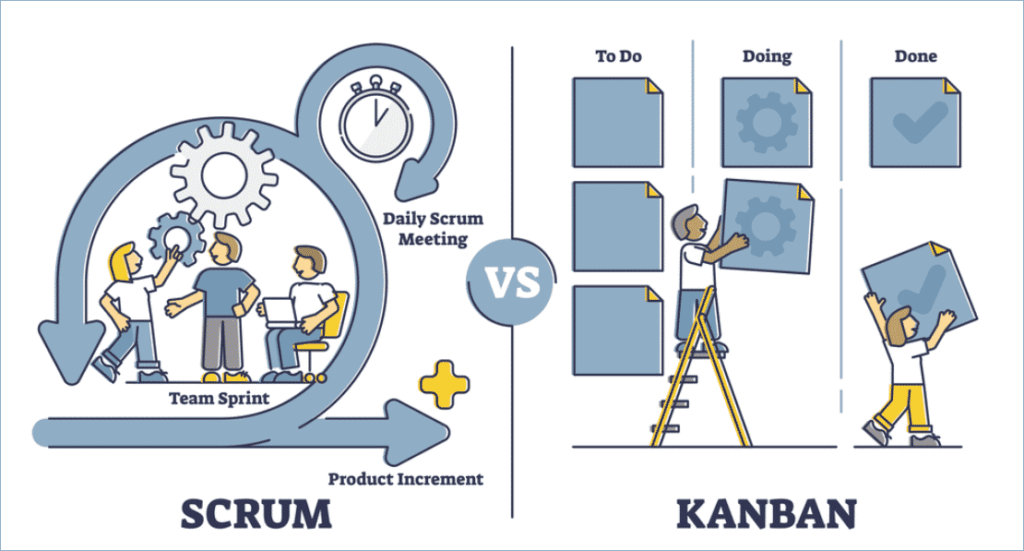
Advantages and Disadvantages of Scrum and Kanban
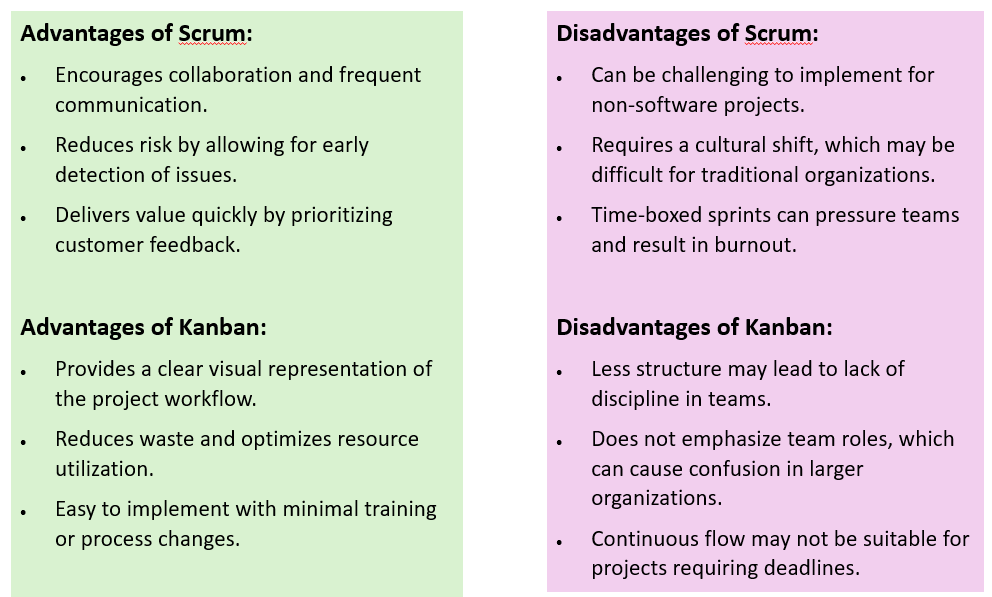
Combining Scrum and Kanban: The Scrumban Approach
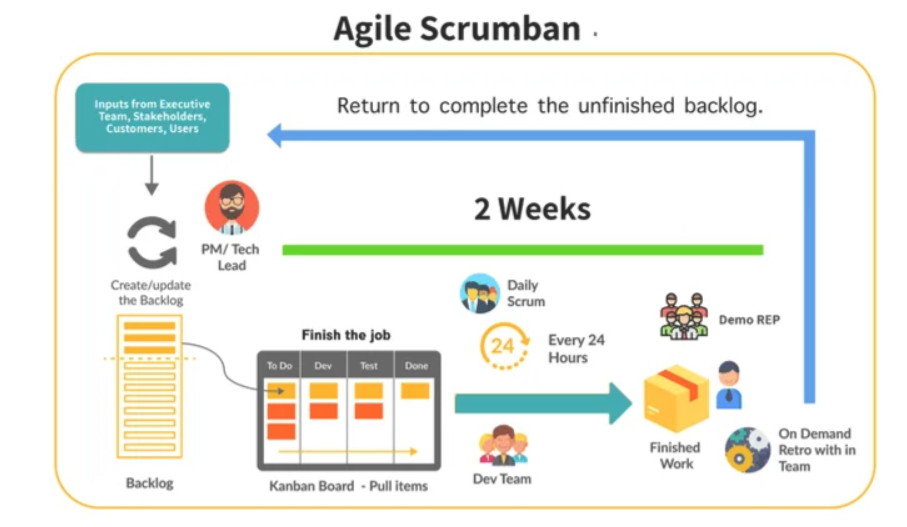
In some cases, organizations choose to combine Agile and Kanban methodologies into a hybrid approach known as Scrumban. This approach borrows the time-boxed sprints from Agile while incorporating Kanban’s visual workflow and work-in-progress limits. Scrumban is beneficial for teams looking to blend the structure of Agile with the flexibility of Kanban, allowing for continuous delivery while maintaining focus on specific goals.
Advantages of Scrumban:
- Combines the best of both worlds by using Agile’s structure and Kanban’s flexibility.
- Enhances team productivity by allowing work to be continuously delivered without the constraints of fixed sprints.
- Provides visibility into project progress and promotes continuous process improvement.
What is SAFe?
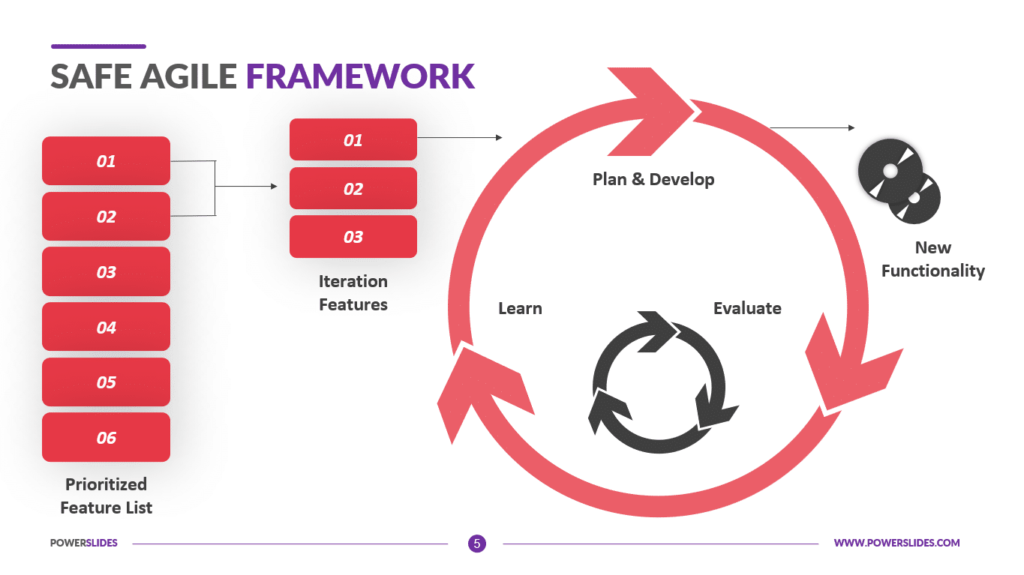
SAFe is a framework built on Agile principles that focuses on rapid delivery, value orientation, and collaboration. It provides building blocks that simplify the application of agility at the organizational level. SAFe encompasses not only team-level activities but also processes at the program, solution, and portfolio levels.
SAFe (Scaled Agile Framework) Project Management is a framework designed to apply Agile principles in large-scale organizations. SAFe scales Agile methodology to enable multiple teams to work in alignment toward shared goals, making it an effective approach for managing large and complex projects involving multiple teams.
The Scaled Agile Framework (SAFe) was first introduced in 2011 by Dean Leffingwell. It was developed as a response to the growing need for applying Agile principles at scale, especially in large organizations managing complex systems and multiple teams.
Dean Leffingwell initially described the framework in his book, “Agile Software Requirements: Lean Requirements Practices for Teams, Programs, and the Enterprise.” Over time, SAFe evolved to address challenges in enterprise-level agility and has become one of the most widely used frameworks for scaling Agile. Today, SAFe is maintained and regularly updated by Scaled Agile, Inc., with the most recent version (SAFe 6.0) being released in March 2023.
Core Structure of SAFe
SAFe is organized into four main levels:
- Team Level:
- Agile teams work using methodologies like Scrum or Kanban.
- Each team delivers its work within sprint cycles.
- Program Level:
- Coordinates multiple teams working on a common product or solution.
- Agile Release Train (ART): Groups of 5-12 teams working in harmony.
- Deliverables are managed in Program Increment (PI) cycles (8-12 weeks).
- Solution Level:
- Used for large and complex products or solutions.
- Manages coordination between multiple ARTs.
- Portfolio Level:
- Manages projects and investments to support organizational strategic goals.
- Value Stream: Focuses on customer value and optimizes resource allocation.
Key Features of SAFe
- Value-Driven Approach:
- SAFe promotes customer-centric work at every level.
- The “Value Stream” concept optimizes processes that create value for the customer.
- Program Increment (PI) Planning: A Program Increment (PI) is a structured, timeboxed period within SAFe during which Agile teams collaborate to deliver a set of features or solutions, ensuring alignment and value delivery across multiple teams working at scale.
- Large-scale planning meetings are held for all teams.
- Teams define the work and objectives to be completed during the PI cycle.
- Roles:
- Release Train Engineer (RTE): Oversees the Agile Release Train.
- Product Manager: Responsible for product management at the program level.
- Solution Architect: Defines technical architecture at the solution level.
- Continuous Delivery:
- Enables rapid response to customer needs with continuous delivery cycles.
- Strategic Alignment:
- Ensures alignment between organizational strategic goals and team activities.
Benefits of Using SAFe
- Coordination: Ensures harmony among multiple teams working together.
- Strategic Management: Effectively prioritizes tasks and allocates resources.
- Flexibility: Adapts quickly to changing business needs.
- Efficiency: Reduces waste and increases customer value.
- Transparency: Promotes clear communication between processes and goals.
When to Use SAFe?
- For large and complex projects.
- When multiple teams are working simultaneously.
- When Agile transformation is targeted across the organization.
- When strategic management and prioritization are required.
Dispiclined Agile
Both Scrum and Kanban offer powerful methodologies for managing projects in today’s fast-paced and ever-changing business landscape. Agile is best suited for projects that require rapid development, collaboration, and adaptability, while Kanban is perfect for streamlining ongoing processes and ensuring continuous delivery. Understanding the strengths and limitations of each approach allows teams to select the most appropriate method—or blend of methods—for their unique needs.
By leveraging the principles of Scrum, Kanban, or even a hybrid approach like Scrumban, organizations can optimize their project management processes, improve productivity, and enhance customer satisfaction.
Nowadays, a new toolkit – not a framework – named Dispiclined Agile that has emerged to address the challenges of adopting, tailoring, and scaling agile practices in organizations. Unlike rigid frameworks (e.g., Scrum or SAFe), Disciplined Agile serves as a customizable set of tools, principles, and practices. It integrates and builds upon ideas from multiple agile approaches, lean principles, DevOps, and traditional project management.
The toolkit empowers teams to navigate complexity, optimize workflows, and achieve sustainable agility. As part of the Project Management Institute (PMI), it is increasingly recognized as a leading solution for scaling and customizing agile across industries.
Conclusion
The future of project management is moving toward a hybrid approach, where organizations combine the best elements of predictive and adaptive methodologies to meet evolving project demands. This trend is driven by the increasing complexity of projects, technological advancements, and the need for agility in a fast-changing world.
The increased use of AI and automation in project management is revolutionizing the way projects are planned, executed, and monitored. These technologies are improving efficiency, enhancing decision-making, and enabling project managers to focus on more strategic aspects of their roles.
As AI and automation continue to evolve, their impact on project management will only increase. These technologies will not replace project managers but will empower them with more accurate data, better tools for decision-making, and more time to focus on strategic leadership. The integration of AI and automation will streamline project workflows, enhance efficiency, and help organizations deliver better results faster.