





How is Cost Control Done in Construction Projects? What do we understand by Project Cost Control?
Common Misconceptions:
- “Secret” calculations done by the accounting department
- Invoice checks and entries into the accounting system
- Comparing actual expenditures with the budget (but what exactly is a budget?)
- Simply not exceeding the budget
- Actions performed by the Technical Office
- Simply not spending money…
Project cost control is far more comprehensive than these answers. To fully understand it, let’s first define the concept of cost.
Cost is the measure (in monetary terms) of the sacrifices and activities made to achieve a goal or obtain an economic value. In short, it refers to expenditures made to achieve economic gains. Construction Project Cost refers to the expenses incurred to complete a project.
Why Are Costs Controlled?
We need to control costs to ensure that our expenses do not exceed the financial gain we aim to achieve. Otherwise, we would end up not generating any profit and working in vain.
The primary purpose of project cost control is to enable the Project Manager to make necessary decisions to complete the project profitably, using a system that provides a realistic and accurate projection of the project’s financial status based on current information. Cost control is the process of accurately predicting and monitoring project costs through quick reporting. It can be compared to a ship navigating open waters, where three crucial questions must be answered:
- Where are we? (Are we on the right course?)
- Where are we heading?
- What do we need to do to get back on track?
Project Cost Control Process Includes the Following Steps:
- Estimating costs
- Establishing an agreed-upon budget
- Controlling actual and forecasted costs against the budget and taking corrective actions
Classification of Costs
For a more effective control and forecasting process, costs are categorized as follows:
- Direct Costs: Costs directly related to project activities.
- Indirect Costs: Costs that do not directly affect project activities but are indirectly related to project completion.
- Fixed Costs: Costs that do not change based on the progress of an activity for a given period.
- Variable Costs: Costs that increase or decrease depending on the amount of work done in a given period.
Cost Control and Accounting
The concepts of cost, expenditure, and expense are also defined within the discipline of accounting. Although cost accounting is a separate discipline, it is typically the Accounting Department that controls product costs in the manufacturing sector. However, in construction projects, the roles of accounting/finance and cost control units differ.
Of course, financial statements reported according to generally accepted International Financial Reporting Standards (IFRS) should be integrated into the decision-making process during a project’s lifecycle, as each project functions as a micro-organization. The accounting function is responsible for reporting the project’s financial status up to a specific point to stakeholders such as project management, sponsors, government entities, and other external parties. In contrast, the role of project cost control is to provide accurate forecasts regarding project expenditures based on current information at any given point, allowing for preparation for potential financial risks and opportunities.
These efforts form the foundation for cash flow management, which serves as input for accounting reports. The expenses recorded in the accounting system also serve as input for cost control. This relationship does not necessarily require the integration of two separate systems but necessitates the collaboration of both disciplines and the consideration of both systems in project management.
Key Differences Between Cost Control and Accounting Systems:
| Cost Control Discipline | Accounting / Finance Discipline |
|---|---|
| Focuses on the future | Focuses on the past |
| Embedded in the project, understands the work | Detached from the project, applies to any business |
| Focuses on commitments | Focuses on invoices and payments |
| Uses fixed exchange rates | Uses variable exchange rates |
| Involves forecasting and risk management | Involves cash flow and financial management |
| Focuses on project completion | Focuses on the end of reporting periods |
Focusing on the future and being able to make predictions is essential for project cost control.
In the manufacturing sector, forecasts are often based on historical data. However, in construction projects, continuous re-estimation is necessary, as they are unique, large-scale investments requiring substantial financial commitments. Therefore, from the design phase onwards, it is crucial to estimate potential costs by considering the project’s duration and resources—this is referred to as cost estimation.
Cost Estimation Methods in Projects
Accurate cost estimation is critical from the very beginning of a project. Generally, four types of estimation methods are used:
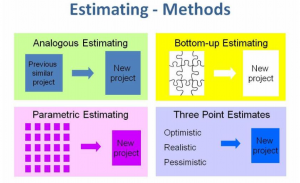
- Analogous Estimation: Early estimates are often made without detailed information, using expert assumptions and comparisons with past projects. These estimates are typically top-down and have a lower level of accuracy.
- Parametric Estimation: During the planning phase, initial estimates are refined as a better understanding of project scope, methods, and resources is gained. This method uses ratios, such as labor or material costs per unit, to calculate costs.
- Three-Point Estimation (PERT): To improve accuracy, three different estimates are made—optimistic (O), most likely (M), and pessimistic (P). The weighted average of these estimates is calculated to predict project costs.
- Bottom-Up Estimation: When there is a high level of uncertainty, costs are estimated at the work breakdown structure (WBS) or activity level, then aggregated to provide a total estimate. Cost estimates detailed by activities are collected bottom-up. Calculated cost estimates are reported under a cost control account or cost code. Contingency reserves are also included in cost estimates by the project manager to cover anticipated risks and address uncertainty in costs. When these studies are approved by the project sponsor, the final Project Budget is formed from the sum of these detailed estimates and the budget is called Cost Baseline.
Determining the Project Budget
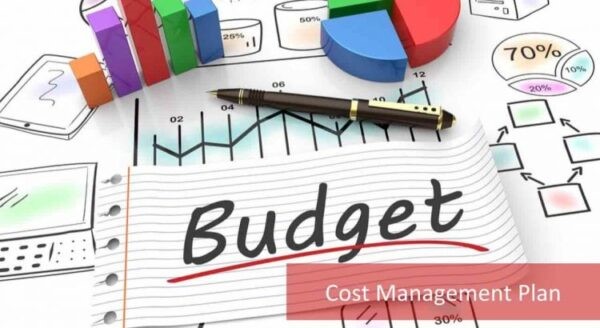
The project budget is the reference table that reports the financial resources of a project and how these resources will be allocated to activities. The budget consists of the following expense items:
Budget Detail Cost Item Estimates
Direct Costs
- Resources (Construction materials, Labor, Equipment)
- Site setup, mobilization, and demobilization costs
- Subcontractor Expenses
- Consumables (hardware, nails, etc.)
- Additional allowances (estimated and extra expenditure allowances – taxes, freight, discounts, etc.)
Indirect Costs
- Administrative expenses (lighting, meals, security, travel, communication, IT, central office expenses, administrative needs, etc.)
- Financial Expenses
Escalation – Cost Increases (inflation, exchange rate differences, etc.)
Contingency – Additional Provisions for Emergency and Foreseen Risks
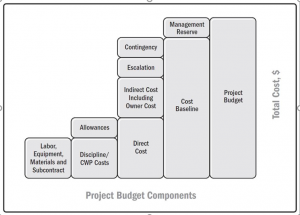
The project cost baseline is a cumulative and time-phased tool used to measure and monitor future project cost performance. When management reserve funds (management reserves) are added to this cost baseline, the project budget is formed. A management reserve is an additional source of funds covering unforeseen events, such as changes in project scope or unidentified risks. The greater the uncertainty, the more management reserve is required.
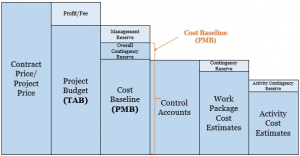
The project manager manages the cost baseline, while the project sponsor retains control over the management reserve funds as part of the broader organizational funds. There must be clear and strict rules for managing these management reserve funds.
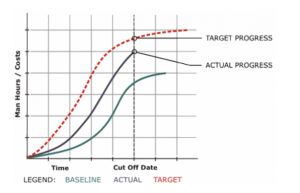
The cumulative usage of the budget over time is displayed in a graph, which forms an “S” curve. A graphical report showing the original budget “S” curve alongside the actual expenditures “S” curve up to date demonstrates how actual expenditures differ from initial estimates and serves as a foundation for future forecasts. This allows for the visualization of cash flows over a certain period and the prediction of future spending trend.
Project Cost Management and Control
Once work begins, costs are monitored directly by the project management team or indirectly through operational accounting systems. To ensure that project managers can rely on system data, they must confirm that costs are recorded accurately. It is essential to verify information both on-site and in the system. This verification is carried out by Project Cost Control Officers assigned to the site.
For effective cost control, Budget Owners who are accountable for each cost item must be designated and report to the Project Manager. Each Budget Owner is responsible for the forecasting and monitoring stages of their budget. However, the ultimate responsibility always lies with the Project Manager.
Actual expenditures in projects inevitably deviate from planned costs. The project manager handles cost management while thresholds requiring sponsor involvement may arise. These are known as cost tolerances. If expenditures are predicted to exceed these tolerances, the manager must notify the sponsor. Periodically, the viability of the project or work program should be formally reviewed. This secondary review also considers “sunk costs” — actual and committed expenses that are non-recoverable, along with potential additional costs from contract cancellations.
Definitions for Project Cost Performance Monitoring
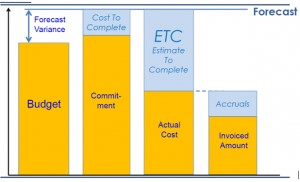
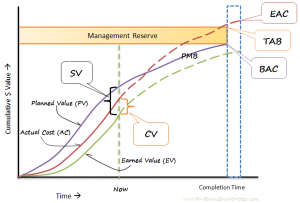
- Budget at Completion (BAC) – Cost Baseline: The project’s reference total budget.
- Estimate at Completion (EAC) – Forecast: The total projected actual costs at the project’s completion.
- Variance at Completion (VAC) – Forecast Variance: While the budget sets out the plan for the project’s desired outcome, the Estimate represents the realistic expectations for project results. The difference is the “variance at completion” (VAC = BAC – EAC). If this variance is above budget, it is funded through management reserves.
- Estimate to Complete (ETC): The estimated remaining cost to complete the project, based on the quantity estimates of remaining work.
- Cost to Complete (CTC): The sum of committed expenditures plus the estimated costs needed to complete the project.
- Commitments (CM): Confirmed orders and contracts for goods and/or services.
- Actual Costs (AC): Costs recorded in accounting, either partially or fully, through invoices and accruals.
- Accruals (AA): Reported but not yet invoiced expenses that are certain to occur.
- Invoiced Amount (IN): Expenses for which invoices have been received.
- Paid Costs (PD): Expenses that have been paid.
Project Cost Performance Monitoring Techniques
The goal of both estimation methods is to predict the project’s estimated completion cost (EAC) because both sponsors and project management are interested in knowing how much and when the project will be completed.
a) Traditional Method: This approach does not directly correlate project progress with cost analyses, using separate monitoring reports instead. In this approach, the project’s completion cost is estimated by adding the costs committed via purchase orders and contracts to the remaining work’s completion cost (Cost-to-Complete).
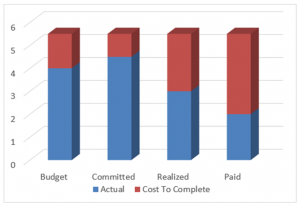
Costs committed, incurred, and paid are tracked on a periodic basis (weekly or monthly) by cost category or code, compared to the budgeted values in that breakdown. At the end of fiscal periods, discrepancies are checked in collaboration with accounting. Control actions and preventive measures are taken if cost overruns are detected. This process focuses on commitments not yet recorded in the accounting system rather than actual expenditures, which consist of invoices recorded in the system.
Why are commitments so crucial? Many construction projects try to measure their budgets against actual costs using data from accounting systems. However, there is a time gap (accounting lag) between when a financial commitment is made (i.e., a purchase order is issued to a supplier) and when it materializes as an invoiced cost.
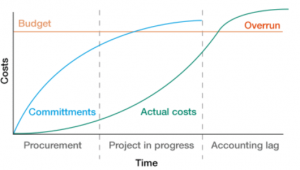
In some cases, this accounting lag can take months, leading to overspending if commitments are not accounted for while analyzing budgets against costs. Using the traditional method: A new estimate is made based on current commitments and remaining work:
EAC = Commitments (CM) + Cost to Complete (CTC).
b) Earned Value Technique (EVT): The traditional approach can be misleading as it does not account for the value of work completed within a specific period. Comparing only the planned budget against actuals is a classical accounting approach. Earned value analysis is a simple way to provide a more complete picture. This technique helps both the client and contractor evaluate project performance by integrating scope, time, and cost metrics.
The concept of Earned Value was introduced by the U.S. Department of Defense in 1967 and has since been adopted by NASA and the construction industry. Earned Value Analysis has a three-dimensional approach:
- Planned Value (PV): The total budget for all planned work up to any given date on the project schedule.
Planned Value (PV) = (Planned Progress Percentage) × Budget (BAC). - Actual Costs (AC): The total resources spent on all completed work at any given point in time.
- Earned Value (EV): The total value of completed work at any given point. This is measured in terms of the Planned Value (PV).
Earned Value (EV) = (Actual Progress Percentage) × Budget (BAC).
Recommendations for Effective Cost Control
- Always consider the client’s (owner’s) needs.
- Strictly adhere to the scope of the main contract and the most recent budget.
- Avoid overly complex cost breakdown structures. Simplicity ensures that all forecast variances are traceable.
- Check the alignment of records with financial accounting systems at least monthly.
- Repeated variances in a work package indicate an underlying problem; investigate thoroughly.
- Accurately measure productivity in completed work packages and use this data to forecast the remaining project.
- Assign Budget Owners who will report to and be accountable to the Project Manager.
- Recognize that productivity changes with physical progress (typically decreases after reaching 80% progress).
- Take immediate action if you observe issues in cost estimates without waiting for the outcome of the entire work package.
- Focus on commitments, not direct invoice records, for uncommitted expenses.
- Avoid using contingency budgets to compensate for cost overruns.
- Interventions should only be for correcting errors, routine accounting adjustments, client-driven changes, or improving the accuracy and integrity of performance measurement data.
“It’s no use saying, ‘We are doing our best.’ You have to succeed in doing what is necessary.”
—Winston Churchill